Natural History
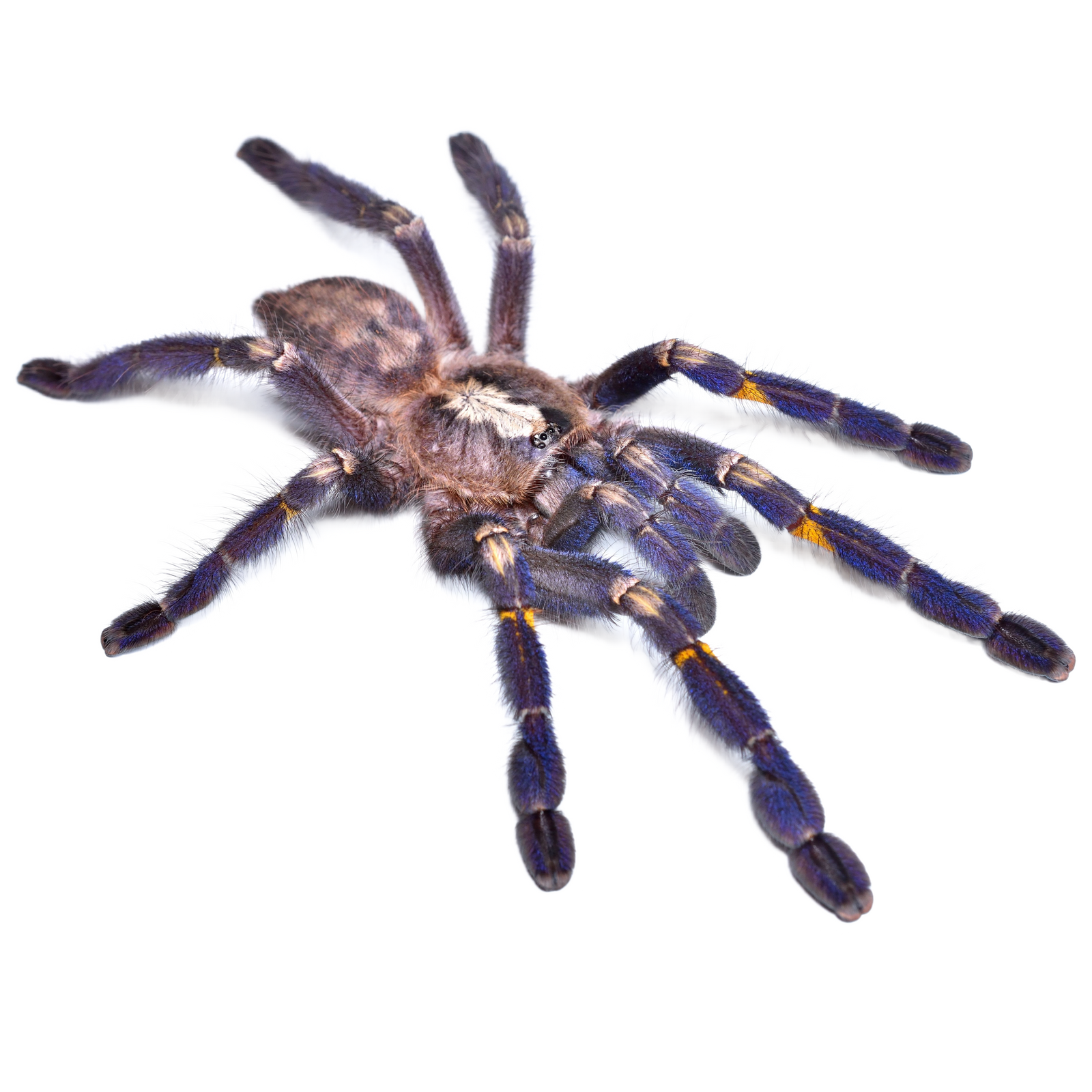
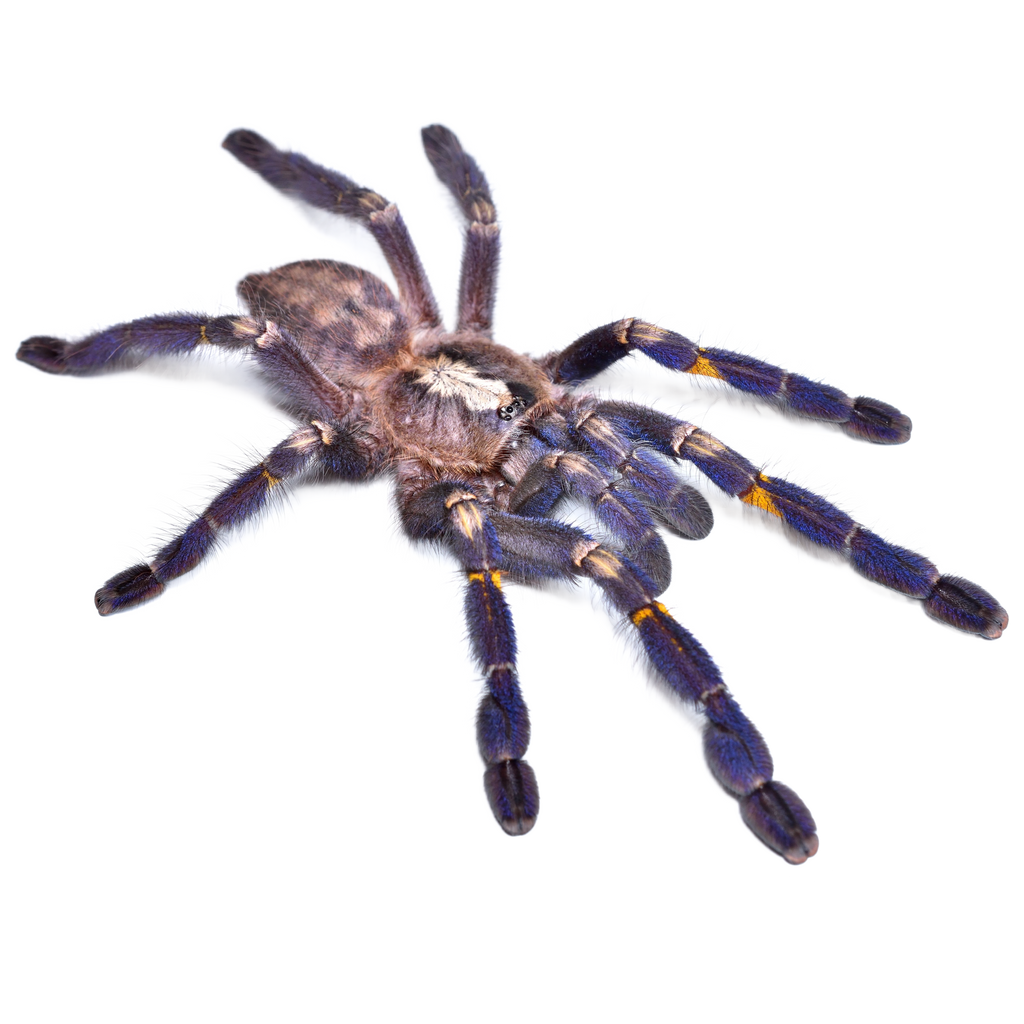
The Gooty sapphire ornamental tarantula is a large, tree dwelling arachnid distinguished by its vivid blue coloration, long legs, and agile build. Females are much longer lived than males. A female may survive for roughly 12 to 15 years, with some individuals potentially living longer under favorable conditions. Males commonly live only about three or four years in total and usually survive for a comparatively brief period after maturity. Precise averages in the wild are difficult to establish because these secretive spiders spend most of their lives hidden inside trees and cannot easily be followed across successive molts.
Within its forest community, the Gooty sapphire ornamental tarantula functions as a midlevel predator. By consuming numerous insects and other arthropods, it helps regulate local invertebrate populations and transfers energy from small prey into a larger predatory animal. It is also prey for birds, arboreal reptiles, small mammals, centipedes, and predatory wasps, particularly during immature stages or while exposed away from shelter. Parasitoid wasps can be especially formidable because they are capable of locating spiders in retreats, immobilizing them, and using them as food for developing larvae.
Several adaptations suit this tarantula to life above the ground. Its long legs bridge irregular bark and gaps between surfaces, while paired claws and dense foot pads provide traction. A flattened profile allows entry into narrow spaces that exclude many predators. Silk reinforces these refuges and extends the spider’s sensory awareness beyond its body. Its habit of remaining concealed by day limits exposure to visually hunting predators and harsh surface conditions. Together, these traits make it an effective nocturnal ambush hunter and an important participant in the food web of mature tree communities.
Conservation Status
The IUCN Red List classified the Gooty sapphire ornamental tarantula as “Critically Endangered” in its 2008 assessment and recorded its population trend as Decreasing. “Critically Endangered" is the highest threat category assigned to a species that still survives in the wild. It indicates an extremely high risk of extinction, not that extinction is inevitable. In this case, the classification reflects an exceptionally restricted known distribution, continued deterioration of habitat, and an apparent decline in the remaining wild population. Precise abundance estimates are unavailable, but the combination of a narrow range and ongoing habitat damage makes the species highly vulnerable to local disturbances.
The principal threat is the loss and degradation of suitable forest. Timber cutting, firewood collection, vegetation removal, and other forms of human pressure reduce the number of mature trees and secure retreats available to these arboreal spiders. Habitat fragmentation can isolate colonies and limit movement between surviving forest patches, increasing the risk that a single fire, development project, or episode of intensive resource extraction could eliminate a substantial portion of the global population. Climate change may intensify existing pressures by altering rainfall, vegetation, and fire patterns, although habitat destruction remains the more immediate concern.
Collection for the wildlife trade is an additional threat. The species’ striking coloration has created strong international demand, and unauthorized removal of spiders from such a small wild population can have disproportionate consequences. Collection may remove breeding adults and further reduce already limited genetic diversity. Breeding has made the species widely available outside its native range and may lessen some demand for wild specimens. However, stocks are not equivalent to a managed conservation population. Many descend from relatively few founders, and there is no widely documented, coordinated reintroduction program demonstrating that captive bred individuals have restored wild populations.
International trade is regulated through the Convention on International Trade in Endangered Species (CITES) of Wild Fauna and Flora, under which ornamental tarantulas of this group are included in Appendix II. This does not prohibit all trade, but it requires legal documentation and controls intended to prevent trade from becoming detrimental to wild survival. Indian wildlife, forest, and export laws also provide mechanisms for restricting unauthorized collection and trafficking.
Part of the known habitat lies within reserve forest, but legal designation is effective only when supported by enforcement and local cooperation. Protection of remaining mature forest, prevention of illegal extraction and collecting, restoration of degraded habitat, and systematic population surveys are the most important conservation priorities. No well established species specific restoration or release program has yet offset the continuing pressures on the wild population. Long term survival therefore depends primarily on safeguarding the small area of natural habitat that remains.
Native Range
The Gooty sapphire ornamental tarantula is endemic to India and has one of the most restricted known distributions among ornamental tarantulas. Confirmed wild populations occur in Andhra Pradesh, in the southeastern portion of the country. The best documented locality lies within the reserve forest between the towns of Nandyal and Giddalur, along the eastern and southeastern margins of the Nallamala Hills. This landscape forms part of the Eastern Ghats, a discontinuous chain of ancient hills running roughly parallel to India’s southeastern coast. The species is not known to occur naturally outside this limited region, and its total range appears to cover only a small area rather than extending throughout the Eastern Ghats.
Despite its common name, the tarantula’s association with the town of Gooty is uncertain. The original specimen was discovered there in a railway timber yard, not in clearly documented natural habitat. It may have arrived inside a hollow log transported from another part of Andhra Pradesh. Later searches did not establish a resident population around Gooty itself, while subsequent records placed the species farther east in the forests between Nandyal and Giddalur. Gooty should therefore be understood as the historical discovery locality rather than the center of the confirmed natural range.
At the broadest scale, the species inhabits tropical dry deciduous forest. This macrohabitat is markedly different from permanently wet tropical rainforest. The forest experiences a pronounced annual dry season, during which many canopy trees shed some or all of their leaves. The landscape is a mosaic of wooded slopes, low ridges, valleys, rocky outcrops, seasonal drainage channels, and patches of more open scrub. Forest structure varies with soil depth, slope, and access to seasonal moisture. Taller, more continuous woodland tends to occur in sheltered valleys and along drainage lines, while exposed ridges may support shorter trees and a more open canopy.
Within this broad forest ecosystem, the tarantula depends on much narrower microhabitats. It is strongly arboreal and is usually associated with mature trees containing deep cavities, trunk fissures, hollow limbs, spaces beneath loosened bark, or sheltered junctions between large branches. These retreats provide darkness, physical protection, and a more stable internal climate than the surrounding forest air. A suitable hollow can retain moisture after rainfall and remain cooler during hot afternoons. The spider may line the entrance and interior with silk, but the underlying structural shelter is provided by the tree itself. Trees with irregular bark, internal decay, old branch scars, or naturally formed hollows are therefore especially important components of its habitat.
The regional climate is tropical and strongly seasonal. The hottest period generally extends from March into May or early June. Exposed daytime temperatures during this season commonly rise through the 90s and may exceed 105°F during severe heat. Nights are cooler, but dry season heat can remain intense on open slopes and in sparsely wooded areas. Deep tree cavities buffer these extremes, often remaining substantially cooler than sunlit bark or exposed rock. Dense foliage, shaded trunks, and sheltered valley positions likewise reduce direct solar heating and slow the loss of moisture. The coolest and driest period usually occurs from about December through February. Daytime temperatures are often in the 70s or low 80s Fahrenheit, while nighttime temperatures may fall into the upper 50s or 60s. Higher or more exposed sites can become cooler.
Annual precipitation across the wider Nandyal and Giddalur region is generally moderate, often around 25 to 40 inches, but it is concentrated into a limited part of the year. Rain may fall in heavy bursts separated by dry intervals, filling seasonal streams and briefly increasing moisture throughout the forest. Temperatures during the rainy season commonly remain between the upper 70s and low 90s.
Relative humidity fluctuates far more than it would in evergreen rainforest. During rainy weather and humid nights, local humidity may exceed 70% and can approach saturation within enclosed hollows. During the dry season, exposed afternoon air may fall below 40%, particularly on open ridges or near scrub. The microclimate inside a shaded trunk cavity is less variable. Retained moisture in decaying wood, accumulated organic material, and protected inner surfaces reduces desiccation even when the surrounding forest becomes hot and dry. This contrast between regional dryness and humid sheltered retreats is a defining feature of the species’ environment.
Much of the occupied region lies from several hundred feet to roughly 2,000 feet above sea level, with nearby ridges rising higher and potentially approaching 3,000 feet. The species is not regarded as a high altitude specialist. Its distribution appears more closely tied to suitable dry forest structure and mature hollow bearing trees than to a narrow elevation band.
Behavior
The Gooty sapphire ornamental tarantula is primarily nocturnal, with much of its visible activity concentrated around dusk and during the night. By day, it usually remains concealed inside a tree cavity, behind loose bark, or within a silk lined crevice. It may rest near the entrance with its legs positioned to detect vibrations while keeping most of its body protected.
Activity changes with seasonal conditions rather than following a true brumation cycle. Warm, humid periods generally support greater prey activity and may encourage more frequent emergence. Mature males become especially mobile during the reproductive season, abandoning much of their previous site fidelity while searching for females. During cooler or drier periods, both sexes may spend longer inside their retreats and respond more slowly to prey. They do not undergo mammalian style hibernation or a clearly defined brumation. Instead, declining temperatures reduce metabolism and movement, sometimes producing prolonged inactivity. This should not be confused with death or severe illness unless accompanied by loss of posture, poor coordination, or other abnormal signs.
This is a solitary species. Mature males are less sedentary than females and devote substantial effort to locating mates. A male detects a female partly through chemical traces associated with her silk and retreat. When he finds a potential mate, he announces himself through rhythmic tapping, drumming, and vibration rather than approaching silently as he would prey. A receptive female may answer with movements or vibrations of her own and emerge cautiously. The male attempts to control the position of her fangs during mating, but the encounter remains dangerous because the female may attack or consume him. Maternal behavior is limited but pronounced: a female guards and manipulates her egg sac, responding defensively to disturbance. Beyond this the species has no enduring family structure or cooperative parental care.
Although it has eight eyes, vision is not its principal source of detailed information. The eyes are most useful for distinguishing light from darkness and detecting nearby changes in movement. Hairs on the legs and body are far more important. These hairs detect air currents, contact, and minute vibrations traveling through bark, silk, or other surfaces. Slit shaped sensory organs in the exoskeleton also register mechanical strain. Chemical information is sampled through sensory structures on the appendages, helping the spider evaluate prey, conspecifics, and familiar surfaces. Its habit of placing several feet at or near the retreat entrance allows it to monitor the surroundings while remaining partly concealed.
Its locomotion is one of its most distinctive traits. This is an agile arboreal tarantula capable of accelerating suddenly across vertical and irregular surfaces. It can reverse direction quickly and may cross short gaps when fleeing. The body is often held close to the surface, improving stability and reducing exposure. Such speed should not be mistaken for aggression. Most rapid movement is escape behavior. However, a frightened individual can move toward a person if that happens to be the nearest route to darkness, creating the false impression of a deliberate charge.
When confronted by a potential danger, repeated tapping, blowing, prodding, or uncovering tends to intensify its response rather than calm it. Threat postures are warnings, not invitations to test its temperament. Individuals vary, with some retreating almost automatically and others standing their ground after repeated disturbance. Handling provides no social benefit and exposes both spider and keeper to unnecessary risk. The species does not form an attachment to people, and apparent calmness usually represents tolerance, immobility, or habituation to predictable background activity rather than trust.
Behavior under human care can differ from their wild counterparts because prey arrives more predictably and predators are absent. Some individuals learn to associate routine vibrations with food and rush toward any movement near their retreat. This conditioned feeding response can be mistaken for aggression. Others remain deeply secretive and emerge only after the room becomes dark. A newly relocated spider may hide, web heavily, refuse prey, or make repeated escape attempts while establishing a secure retreat. Persistent exposure, frequent disturbance, and forced interaction can maintain this stress response. A well settled individual often creates a recognizable network of silk and uses regular resting and hunting positions. Normal behaviors include prolonged stillness, grooming each leg and the mouthparts, rearranging silk, closing the retreat before a molt, and temporarily refusing prey.
Husbandry Requirements
Enclosure Design
The Gooty sapphire ornamental tarantula requires a vertically oriented enclosure that accommodates climbing. An established juvenile with a leg span of approximately 2 to 4 inches should have an enclosure measuring at least 8 inches long, 8 inches deep, and 12 inches tall. Increase the enclosure as the animal grows. An adult should receive a minimum of 12 inches long, 12 inches deep, and 18 inches tall, although an enclosure measuring 18 inches long, 18 inches deep, and 24 inches tall provides more room for structured climbing and retreat construction. Excessive open height should be avoided because a fall onto hard furnishings can cause serious injury.
Provide a vertical cork bark tube, broad slab, or similarly textured retreat that extends through much of the enclosure. Position it securely against the back or one side, leaving enough space behind it for the tarantula to hide and construct webbing. A second sheltered option near the lower portion of the enclosure allows the animal to choose among different moisture and temperature conditions. Artificial foliage, anchored branches, and cork ledges can break up exposed space, but the enclosure should not be crowded so densely that routine observation becomes impossible.
Use a tightly fitted, locking lid or secure front opening doors. Ventilation holes must be smaller than the tarantula’s carapace, and sliding doors should overlap closely enough to prevent access to the track. Secure cable ports with fitted plugs. Magnetic closures alone may be inadequate unless they are unusually strong and backed by a latch. Inspect door seams, ventilation panels, and lid clips regularly. Perform maintenance with the room door closed and unnecessary openings blocked, since this fast arboreal tarantula can exploit a momentary gap.
Lighting and Heating
This species does not need ultraviolet light to synthesize vitamin D in the manner of many reptiles. If the enclosure contains live plants, use a low intensity visible spectrum LED positioned outside the enclosure. Place it above the roof rather than against a side panel, and ensure that foliage, bark, and shaded retreats remain available throughout the day.
Maintain a daytime ambient temperature of 74℉ to 80℉. The upper portion may reach 78℉ to 80℉, while the lower retreat can remain around 72℉ to 76℉. No focused basking spot is required or recommended. Temperatures above 84℉ should be avoided, especially when ventilation is limited. A nighttime decrease to 68℉ to 74℉ is appropriate, but prolonged exposure below 65℉ should be prevented.
Heating the room is safer and more stable than heating the enclosure directly. If supplemental enclosure heat is unavoidable, attach a low wattage heat panel or heat mat to the outside of one side or the rear, never beneath the substrate. Heating from below can dry the lower retreat, disrupt the moisture gradient, and prevent the animal from moving downward to cool itself. Overhead ceramic heaters and powerful lamps are generally unsuitable because they create intense hot zones and rapidly reduce humidity. Never use a heat rock.
Every heating element must be controlled by a reliable thermostat. Place the thermostat probe securely against the heated enclosure surface or within the warm zone where it cannot be displaced. Verify conditions with separate digital thermometers positioned in the upper and lower portions of the enclosure. Surface temperatures on bark near any heater should also be checked with an infrared thermometer. Do not judge temperature by touching the enclosure wall.
Provide approximately 12 hours of light and 12 hours of darkness each day with an automatic timer. The room should become genuinely dim at night, without bright lamps shining into the enclosure. A modest seasonal variation from about 11 hours of light during winter to 13 hours during summer is acceptable, but abrupt changes are unnecessary. Stable lighting cycles support normal activity and resting patterns. Any seasonal temperature adjustment should remain slight and should never push conditions outside the safe ranges.
Substrate and Enrichment
Provide 3 to 5 inches of substrate in an adult enclosure, with slightly greater depth toward the back and around the base of the main cork retreat. Although this tarantula spends much of its time above ground, a substantial substrate layer cushions falls, holds moisture, and permits excavation around the retreat. Firmly pack the substrate so that it supports bark and branches without collapsing.
ReptiEarth is suitable as the primary moisture retaining substrate. It may be used alone or mixed with small grade ReptiChip to improve structure and air spaces. A practical mixture is approximately two parts ReptiEarth to one part prepared ReptiChip. Additional ReptiEarth can be concentrated in the lower layers, while a light scattering of ReptiChip on the surface helps prevent the enclosure floor from remaining muddy. The mixture should feel slightly cool and cohesive below the surface, not saturated or dripping. TropicalBase is also a good choice of substrate for this species as it replicates the natural environment and holds moisture well.
Enrichment should emphasize safe vertical movement, concealment, and opportunities to modify the environment. Use cork bark in several orientations, including one main upright retreat and one or two diagonal branches connecting different levels. Broad branches are preferable to thin, flexible twigs. Artificial or sturdy live foliage can provide visual barriers and web attachment points. Plants must be free of pesticides, fertilizers, and sharp supports, and their watering requirements must not force the enclosure to remain wetter than the tarantula requires.
Enrichment can come in many forms and is for the stimulation of your animal. The five types of enrichment you can offer are food related, sensory, physical habitat, cognitive, and social. These categories have a vast variety of options to choose from that are appropriate for the species being enriched.
Humidity and Hydration
Maintain relative humidity generally between 65% and 75%, while preserving strong ventilation and allowing the surface layer to dry partially between applications of water. Brief increases toward 80% are usually less concerning than constantly wet substrate, but persistent saturation and condensation indicate inadequate airflow or excessive misting. Humidity should come primarily from a moist lower substrate layer and gradual evaporation rather than from keeping every surface wet.
Lightly mist part of the enclosure about two or three times per week, adjusting the schedule according to ventilation, room humidity, and the rate at which the substrate dries. Direct the spray toward one wall, foliage, and a limited area of substrate. Do not spray the tarantula or flood its retreat. Allow another portion of the enclosure to remain comparatively dry so the animal can select its preferred conditions. During naturally humid household periods, misting may be needed less often. In dry heated rooms, carefully moistening one lower corner may provide steadier humidity than frequent heavy spraying.
Provide constant access to a shallow, stable water bowl. For adults, a dish approximately 2 to 3 inches wide is usually adequate. Place it where it can be reached without crossing unstable furnishings, and consider adding a securely mounted elevated cup near the primary retreat. Keep the bowl filled with fresh water and rinse it whenever substrate, webbing, or debris accumulates. Do not use sponges, gels, or absorbent material in the bowl.
This tarantula may drink directly from the bowl or collect droplets from webbing and nearby surfaces after gentle misting. Droplets are supplemental and do not replace a permanent water source. Monitor humidity with a calibrated digital hygrometer positioned near the middle of the enclosure rather than directly above damp substrate.
Diet & Supplementation
In the wild, this tarantula is an opportunistic arboreal predator whose diet consists primarily of insects and other arthropods. Prey includes cockroaches, crickets, katydids, moths, beetles, larvae, and other spiders encountered on tree trunks, in crevices, or among foliage. Large individuals may occasionally overpower small vertebrates such as geckos or frogs, but vertebrates are incidental prey rather than a dietary requirement. The tarantula detects prey mainly through vibrations transmitted through surfaces and air movement sensed by specialized setae and sensory organs on the legs. After a rapid strike, it grips the prey with its pedipalps and chelicerae, injects venom through the fangs, and mechanically crushes the prey while digestive fluids liquefy its tissues. The resulting material is consumed as a liquid, leaving behind a compact bolus of indigestible remains.
Young spiderlings take very small, soft bodied arthropods, while juveniles and adults progressively tackle larger and more heavily armored insects. Seasonal prey availability in the native habitat probably produces periods of abundant feeding during warmer, wetter weather and reduced intake during less favorable periods. Feeding should not attempt to force a constant growth rate. Mature males commonly eat less frequently than juveniles and adult females, and healthy individuals of any age may periodically fast.
Suitable prey includes appropriately sized roaches, crickets, locusts, grasshoppers, silkworms, hornworms, mealworm larvae, and occasional other commercially cultured feeder insects. Roaches, crickets, and locusts are useful staples, while fatty larvae such as waxworms should be occasional foods. Use captive bred feeders from reputable sources. Wild caught insects may carry pesticides, parasites, or environmental contaminants and should be avoided. A varied rotation is preferable to dependence on one feeder species.
Spiderlings can receive small prey two or three times per week. Pinhead crickets, tiny roach nymphs, flightless fruit flies for the smallest individuals, or sections of freshly killed larger insects are appropriate. Juveniles generally do well with one or two prey items every five to seven days. Adults can usually be offered one substantial insect every seven to fourteen days, with the interval adjusted according to body condition and appetite. Mature males may need offers only every ten to fourteen days and may refuse repeatedly.
As a conservative rule, an individual prey item should be no longer than the tarantula’s abdomen and should not be substantially bulkier than the spider’s carapace. Several small feeders are safer than one exceptionally large or aggressive feeder. Large crickets and mealworm beetles can bite, while burrowing larvae may disappear before being eaten. Count all prey offered and remove anything uneaten, particularly if the tarantula does not attack promptly.
Digestion and feeding responses are generally reliable in the mid to upper 70s. If food is refused, remove it and try a smaller or different feeder after several days. Persistent refusal becomes more concerning when accompanied by progressive abdominal shrinkage, weakness, poor coordination, or failure to respond normally.
Reproduction
Reproductive maturity depends more on growth rate, body condition, and molt history than on age alone. In managed settings, males may mature in roughly two to three years, while females commonly require three to five years or longer. A male becomes sexually mature after his ultimate molt, when the ends of his pedipalps develop enlarged palpal bulbs used to transfer sperm. He generally becomes more active after this molt and may wander frequently in search of a female. Females continue molting after reaching maturity and can remain reproductively active for many years. A prospective female should be fully mature, well conditioned, and neither approaching a molt nor recently molted. Pairing should be postponed until a recently molted female has hardened completely and resumed normal activity.
Sexual dimorphism becomes most apparent at maturity. Females are generally heavier bodied, with a broader abdomen and more substantial legs. Mature males are slimmer and leggier, with proportionally smaller abdomens and conspicuous palpal bulbs. Color and pattern may differ somewhat between the sexes, but coloration is not a dependable means of sexing immature animals.
Before mating, a mature male produces a small sperm web. He deposits sperm onto this web and then draws it into his palpal bulbs. A male that has completed this process is often described as charged. He may repeat the process during his mature life, particularly after an unsuccessful introduction or a completed mating. Evidence of a sperm web, active courtship, and normal use of both pedipalps improves confidence that the male is ready, although the web itself may be hidden or destroyed before the keeper notices it.
Courtship relies primarily on vibration and contact rather than vision. When a male detects a receptive female through silk and chemical cues, he usually taps or drums with his legs and pedipalps. He may advance, pause, and repeat these signals at the entrance to her retreat. A receptive female may answer with tapping, emerge slowly, raise the front of her body, or permit the male to approach without striking. The male then attempts to lift and control the female’s front legs and fangs while positioning himself beneath her. He inserts one palpal organ, and sometimes then the other, into her reproductive opening. Sperm is stored within the female’s spermatheca until the eggs are laid, when fertilization occurs.
Mate selection should emphasize confirmed maturity, good body condition, and unrelated ancestry whenever records are available. A vigorous male is preferable to one that is weak or nearing the end of his mature life. Female size alone does not prove maturity, and pairing an immature female can result in rejection or injury. Receptivity also varies over time. A female may initially respond to courtship but later drive the male away, particularly if she is nearing a molt, disturbed, or not reproductively primed. A successful pairing therefore depends on behavioral compatibility as well as physical maturity.
This species is oviparous. After successful mating and an appropriate period of seasonal conditioning, the female lays fertilized eggs and encloses them within a silk egg sac inside a secure retreat. A female may retain viable sperm for an extended period, so egg production does not necessarily follow immediately after copulation. Some females may also use stored sperm after a later seasonal change. Conversely, copulation does not guarantee fertility. An insertion may be incomplete, the male may have transferred little sperm, or the female may molt before laying, which removes the stored sperm along with the lining of the reproductive tract.
Environmental cycling can improve breeding success, although severe cooling is neither necessary nor appropriate. A useful approach is to provide a mild dry season followed by a warmer, wetter period resembling the onset of monsoon conditions. During the drier phase, daytime temperatures can remain around 76℉ to 80℉, with nights falling several degrees. Humidity should be allowed to fluctuate rather than being held constantly high, while the female’s retreat remains suitable and she is not subjected to prolonged dryness. A dramatic winter cooling period should be avoided.
The transition into the breeding season can be signaled by raising daytime temperatures gradually toward 80℉ to 84℉, maintaining a modest nighttime drop, and increasing the frequency of moisture entering the enclosure. This should create cycles of dampening and drying, not stagnant or saturated conditions. Increased humidity must be accompanied by strong air exchange because continuously wet, poorly ventilated surroundings can suppress normal behavior and encourage the female to abandon or remodel her retreat. Seasonal changes should be gradual over several weeks rather than abrupt.
Photoperiod can be adjusted at the same time. A shorter schedule of approximately 11 hours of light during the drier period may be increased gradually to about 12 or 13 hours as warmer and wetter conditions begin. The light should establish a day and night rhythm without shining intensely into the retreat. Changes in room temperature, rainfall simulation, and day length together are generally more persuasive reproductive cues than any single adjustment. It is generally preferable to introduce the male into the female’s enclosure, placing him away from her entrance and allowing him to detect her webbing. The enclosure should provide enough open vertical surface for courtship, a stable retreat for the female, and a clear route by which the male can withdraw.
A reproductively prepared female requires a dark, secure nesting retreat that she can close with silk. An upright hollow, deep crevice, or similar protected cavity is preferable to an exposed area. The structure must be stable because disturbance or collapse can prevent nesting. Once the female becomes reclusive, increases webbing, or seals herself inside, unnecessary vibration, opening of the retreat, and frequent enclosure maintenance should cease. Repeated disturbance can cause delayed laying, abandonment of reproductive behavior, or destruction of the egg sac.
Incubation & Neonate Care
This species is oviparous, meaning the female lays eggs. At deposition, she lays the eggs onto a dense silk mat, folds the silk around them, and forms a rounded egg sac. A successful sac may contain roughly 50 to 150 eggs, although smaller and larger clutches occur. The female normally retains, guards, and periodically rotates the sac with her mouthparts. This rotation distributes moisture and prevents the developing eggs from remaining pressed against one surface.
The female should experience as little disturbance as possible while constructing and guarding the sac. Her enclosure should remain quiet, dim, and secure, with no unnecessary maintenance beyond cautious replenishment of water. Maintain approximately 75% to 80% relative humidity and a temperature of 75℉ to 80℉. The substrate should be slightly moist below the surface but never saturated. Adequate cross ventilation is essential because warm, stagnant air and persistently wet substrate encourage mold, mites, and bacterial growth. Temperatures above 82℉ can accelerate development but also increase dehydration, malformed development, and loss of the sac. Prolonged temperatures below 70℉ may significantly delay development.
Maternal incubation is usually the least disruptive option when the female is calm and the enclosure remains stable. Disturbance may cause her to abandon, damage, or consume the sac, particularly during its earliest development. Nevertheless, some keepers remove the sac for artificial incubation, commonly after approximately four to five weeks. Removing it earlier requires more delicate management because the eggs are highly vulnerable to drying, abrasion, and fungal contamination. Any attempt to take a guarded sac from this exceptionally fast and defensive tarantula should be performed without direct hand contact and only by an experienced keeper using secure containment.
For artificial incubation, the developing eggs or immature spiderlings should not lie directly on wet substrate. An effective incubator uses a ventilated container with a suspended fine mesh tray or perforated inner cup above a lower layer of damp vermiculite or perlite. The lower medium should be moist enough to maintain humidity but should contain no standing water. Contact with wet vermiculite, condensation, or pooled droplets can suffocate or contaminate the eggs. Keep the incubator at 76℉ to 80℉ and approximately 75% to 85% relative humidity, with gentle air exchange. If loose eggs are removed from the sac, they require careful repositioning at least once or twice daily with a clean, soft tool to imitate maternal rotation. Once they develop visible legs and begin moving, frequent manual turning is no longer necessary.
Development generally takes six to eight weeks from deposition to the first recognizable immature stage, but temperature, moisture, and the developmental stage at which a sac is opened can alter the apparent duration. The young initially become largely immobile first instars, sometimes called eggs with legs. They still depend on internal yolk reserves and cannot hunt. They subsequently molt into mobile second instars, often about eight to ten weeks after deposition under stable conditions. Cooler incubation can extend this period. Individuals within one sac may develop at slightly different rates, so they should not be forced from the sac before they are capable of coordinated movement.
Hatching is gradual rather than a single event in which fully independent spiderlings abruptly leave conventional shells. The embryos develop within thin membranes, pass into the first instar stage, and later molt into active spiderlings. The mother does not feed the young. If the sac remains with her, she may eventually open it or permit mobile spiderlings to emerge. Maternal protection is temporary, and there is no assurance that she will tolerate the young indefinitely. Spiderlings should be collected once they are independently mobile, before they disperse throughout the enclosure or become vulnerable to cannibalism.
Major causes of incubation failure include excessive moisture, inadequate ventilation, severe drying, unstable temperatures, contamination by mites or mold, and repeated disturbance of the female. Heavy condensation on the incubator walls indicates that ventilation or temperature control requires adjustment. Mold affecting only a small amount of surrounding silk may sometimes be removed with clean forceps, but discolored, collapsed, leaking, or foul smelling eggs should be isolated promptly. Healthy eggs and first instars are plump and evenly colored rather than shriveled or darkened.
Egg retention or failed deposition is uncommon but can occur. In an oviparous tarantula, dystocia refers to an inability to deposit eggs normally or complete the egg sac rather than difficulty delivering live young. Warning signs may include prolonged abnormal straining, progressive weakness, unusual swelling, or leakage from the reproductive opening. These signs can also have other causes and should not be treated by squeezing or manipulating the abdomen. There is no safe routine home technique for extracting retained eggs. A veterinarian experienced with invertebrates should be consulted, although treatment options may be limited.
Newly mobile spiderlings should be separated from the mother. Although siblings are sometimes raised together temporarily, communal rearing carries a persistent risk of cannibalism, especially when individuals differ in size or access to food. Individual housing also makes it easier to monitor feeding, hydration, molts, and growth. Each spiderling can be placed in a secure, ventilated vial or small arboreal container about 2 to 4 inches tall, scaled so the animal can locate prey easily. The lid and ventilation holes must be escape proof because very small spiderlings can pass through surprisingly narrow openings.
Provide about 1 inch of compacted coconut fiber substrate, along with a small upright strip of cork bark, textured plastic, or another stable climbing surface. A few artificial leaves or silk anchor points allow the spiderling to construct a retreat. The arrangement should emphasize usable vertical structure without creating a long fall onto hard decorations. The substrate should be lightly moist in one area and drier elsewhere. Constantly soaked substrate is hazardous and often drives spiderlings to cling continuously to the lid or walls.
Maintain neonates at approximately 75℉ to 80℉, avoiding direct sunlight, heat lamps, and unregulated heat pads. Small containers can overheat or dry out quickly, so room heating is safer than applying concentrated heat to individual vials. Relative humidity around 75% to 80% is appropriate, but ventilation and substrate conditions are informative. Slightly moist substrate combined with cross ventilation is preferable to frequent heavy misting.
First instars should not be fed because they cannot hunt and remain sustained by yolk. After the molt to the mobile second instar, wait until the body has firmed and the fangs have darkened, usually five to seven days, before offering food. Suitable first meals include flightless fruit flies, very small roach nymphs, pinhead crickets, or pieces of freshly killed prey. Prey should be no larger than approximately half the spiderling’s body length. Offering one small meal every three to four days is generally sufficient. Uneaten live prey should be removed within 12 to 24 hours and immediately if the spiderling appears ready to molt.
Hydration can be provided by placing small droplets on the enclosure wall, webbing, or a leaf two or three times weekly while keeping part of the substrate lightly moist. Do not spray the spiderling directly. Once the animal is large enough to use one safely, provide a very shallow water dish that cannot tip. Dehydration is indicated by a shrunken abdomen, weakness, or tightly curled legs, but excessive wetness is equally dangerous because it promotes poor air quality and microbial growth.
Common neonate problems include desiccation, failed molts, prey injury, mold, mites, falls, and escape. A spiderling that refuses food and becomes darker may simply be approaching a molt. Remove prey and avoid vibration, rehousing, or spraying during this period. Direct handling should never be attempted. Even small individuals are extremely quick, fragile, and capable of defensive biting. Maintenance and transfers should take place inside a larger escape proof container using catch cups, soft tools, and deliberate movements rather than hands.
Conclusion
Successful care of the Gooty sapphire ornamental tarantula begins with recognizing it as a fast, solitary, tree dwelling ambush predator rather than a display animal that benefits from handling. Good husbandry also respects the animal’s nocturnal, vibration sensitive behavior. Prolonged concealment, web maintenance, grooming, temporary fasting, and closing the retreat before a molt are normal. Cohabitation, frequent disturbance, bright nighttime lighting, and direct handling provide no benefit and create risks of cannibalism, escape, biting, and falls. During premolt and molting, the enclosure should remain quiet and prey free while the vulnerable new exoskeleton hardens.
This species demands secure equipment, careful environmental monitoring, disciplined maintenance, and acceptance that it may remain hidden much of the time. With females potentially living roughly 12 to 15 years and males commonly living about three or four years, acquisition represents a serious long term commitment rather than a short lived novelty.